Xeriscape or Softscape? The Right Answer for Most Kamloops Yards Is Both
Stand in any Kamloops backyard in late July, and you can feel the question forming. The sage hills behind the fence don’t water themselves. The Thompson Valley sun has a way of making a thirsty lawn look exhausted by August. So you start asking: keep fighting for the traditional lush yard, or give up on it and go xeriscape?
That framing is almost right, and almost wrong. Xeriscape isn’t the opposite of softscape; it’s a particular type of softscape, built for dry climates. Once you see it that way, the question stops being either/or and becomes one of proportion: how much of your softscape should be water-wise, and where.
Here’s how we think about it at Sirocco.
What softscape actually means
Softscape refers to the living, growing elements of your landscape: trees, shrubs, perennials, grasses, lawns, ground covers, soil, and mulch. It’s everything that breathes, blooms, and changes with the seasons. The “soft” is a contrast to hardscape, the patios, walkways, retaining walls, and other built structures that hold the design together.
In other words, softscape is a category, not a style. A traditional manicured lawn with rose beds is softscape. So is a meadow of native bunchgrasses. So is a gravel garden full of yarrow and sedums.
That distinction matters because the moment you start a landscape project in Kamloops, someone (your neighbour, a contractor, a friend) is going to ask whether you’re “going xeriscape or going traditional.” It’s a useful shorthand. It’s also slightly misleading.
What xeriscape actually means
Xeriscape comes from the Greek xeros, meaning dry. The concept was developed in Denver in the 1980s as a response to drought, and it’s built around seven principles: smart planning and design, soil improvement, efficient irrigation, appropriate plant selection, practical turf areas, mulching, and ongoing maintenance.
Notice what’s not on that list: rocks instead of plants. Cacti everywhere. A “moonscape” yard. Those are stereotypes, and they’re the reason a lot of homeowners write off xeriscape without giving it a real look.
A well-designed xeriscape in Kamloops can include:
- Drought-tolerant perennials like Russian sage, yarrow, lavender, hyssop, and rudbeckia
- Native shrubs such as saskatoon, mock orange, and Oregon grape
- Ornamental grasses that handle wind and heat
- A reduced (but still present) lawn area, often in a more drought-tolerant grass blend
- Efficient drip irrigation instead of spray heads
- Thick mulch to lock in soil moisture
The result doesn’t look sparse. It looks intentional, textured, and seasonal. It’s the kind of yard that gets more interesting in August, not less.
What the hybrid looks like in practice
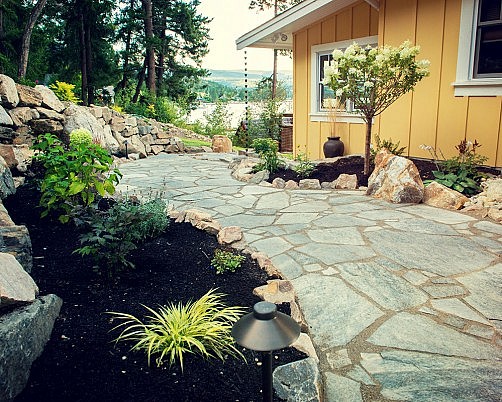
For most Kamloops yards, the answer is some thoughtful mix. A small, well-used lawn near the back door for kids and dogs. A xeriscaped front bed that doesn’t need babysitting. A shaded perennial garden under the deciduous trees where it stays cooler. A native-plant border along the fence line where you want privacy without maintenance.
That’s not a compromise. That’s just good design, applied honestly to a climate that punishes inattention.
What works specifically in Kamloops
Kamloops sits in one of the driest regions in Canada. Average rainfall is around 280 millimetres a year. Summer temperatures regularly push into the mid-30s, and water restrictions are now a routine part of the summer calendar. The City has been steadily pushing residents toward water-wise landscaping, and that direction isn’t going to reverse.
The same climate logic applies whether you’re in town or out at a property on Nicola Lake or Glimpse Lake: hot, dry summers, real winters, and soil that doesn’t always cooperate. That reality reshapes the calculation for most homeowners.
Water cost is real and rising. A heavily irrigated traditional yard isn’t just expensive to install. It’s expensive to keep alive. Water-wise design pays for itself over the years your family lives in the house.
Soil is the starting point. Much of the Kamloops area has thin, sandy, or rocky soil that drains fast. A landscape plan that doesn’t account for soil amendment is going to underperform, whether it’s traditional or xeriscape.
Aspect matters more here than in wetter climates. A south-facing slope behaves very differently from a shaded north side. The plants that thrive in one will struggle in the other. Local experience makes the difference.
Maintenance fits the season. A xeriscape isn’t no-maintenance, nothing is. But it shifts the work: less mowing and watering, more pruning and editing of plant selections over time.
Questions worth asking yourself
When you’re trying to decide where your yard should land on the spectrum, a few honest questions help.
How do you actually use your outdoor space? A family with young kids has different needs than empty-nesters who entertain on a patio. Lawn earns its keep where it gets walked on. Where it doesn’t, it’s mostly a water bill.
What’s your appetite for upkeep? Some people love getting their hands in the soil every weekend. Others want a yard that looks after itself between summer trips. Both are valid; they lead to very different plans.
What’s the look you’re after? Some homeowners want the structure and clean lines of a more traditional design. Others want something that feels like an extension of the surrounding sage and grassland. Either is possible. It’s a design decision, not a budget one.
What’s the long horizon? If you plan to be in the house for fifteen years, water-wise design is almost always the smarter investment. If you’re styling for a sale next spring, curb appeal calculations shift.
How we approach it
We design most Kamloops yards as hybrids, because that’s almost always what fits. A thoughtful landscape design looks at the whole property: sun exposure, slope, soil, how you use the space, the look you want. From there, we match plant selections and irrigation to each zone. The lawn goes where the lawn earns its place. The xeriscape goes where it’ll actually thrive. The mulch, drip lines, and soil amendments do the quiet work underneath.
If you want to see how that comes together on the planting side specifically, our softscaping page walks through how we approach plant selection, soil work, and installation for properties across Kamloops and the surrounding area.
The bottom line
Xeriscape vs. softscape isn’t really a fight. It’s a question of proportion, and for a Kamloops yard, the proportion almost always leans water-wise. The best yards in this valley aren’t the ones that fight the climate hardest. They’re the ones designed to work with it.
If you’re starting to think about a project this year, the earliest design conversations are the most valuable ones. The right balance is much easier to plan into a yard than to retrofit later.
Frequently asked questions
Is xeriscape just rocks and cacti?
No, and that’s the most common misconception we hear. A well-designed Kamloops xeriscape uses a wide palette of drought-tolerant perennials, native shrubs, and ornamental grasses. It can be every bit as full, textured, and seasonal as a traditional planting plan. Rocks and gravel are tools in the toolbox, not the whole toolbox.
Can we convert part of an existing lawn to xeriscape instead of doing the whole yard?
Yes, and it’s one of the most popular ways to ease into the idea. Many homeowners start with the front yard, or with a hot, exposed strip along the driveway or sidewalk, and keep a smaller lawn area in the back where it gets used. It’s a lower-risk way to test the look and the maintenance change before going further.
Is xeriscape cheaper to install than traditional softscape?
Not always. A good xeriscape still requires soil amendment, efficient drip irrigation, quality plant material, and proper mulching, and that adds up. Where xeriscape consistently wins is the long-term operating cost: less water, less mowing, less fertilizer, and fewer stressed plants to replace every few years.
Will xeriscape work in shaded areas of my yard?
Yes, with the right plant choices. Xeriscape is about matching plants to conditions, not just about full sun. Shaded zones have their own palette of low-water options that look great and need less attention than a traditional shade garden.
Do you service areas outside of Kamloops?
We do. In addition to Kamloops and neighbouring communities like Aberdeen, Sahali, Juniper, and Dallas, we take on projects out at Nicola Lake, Glimpse Lake, and across the surrounding region, depending on scope.
Ready to get started?
Request a quote and a project manager will be in touch within one business day.
Sirocco Landscapes designs and installs residential landscapes throughout Kamloops, BC. Explore our full range of services or browse the project gallery to see recent work.
More Articles
-
 September 24, 2026
Getting a Kamloops Yard Ready for Winter: What to Do Before the First Hard Freeze
By the third week of September the mornings in the valley have an edge to them, the sprinklers are still ...
Read Article -
September 14, 2026
Pond, Pondless Waterfall, or Fountain? Choosing a Water Feature for Your Kamloops Yard
“Pond experts near me.” It is one of the searches that brings people to us, and it tells you something: ...
Read Article -
July 24, 2026
Hardscaping in Kamloops: Patios, Walls, and Walkways That Actually Hold Up
Take a walk through an older Kamloops neighbourhood in early spring and you can read the winters in the hardscape. ...
Read Article