What a Backyard Waterscape Actually Costs in Kamloops (And What You Get For It)
There’s a moment that tends to happen on a hot Kamloops evening, usually with a drink in hand on the patio. You hear water somewhere, a neighbour’s fountain, a creek on a hike you took last weekend, and you think: I’d actually use that. A bit of running water out here would change this whole space.
Then the second thought arrives, and it’s usually some version of: that’s probably either out of reach or not worth it.
This article is about both halves of that thought: what a backyard waterscape really costs in Kamloops, and what you get for the money. The clients who end up happiest with a water feature are the ones who knew the trade going in.
First, what counts as a “waterscape”
“Water feature” covers a lot of ground, and the cost conversation only makes sense once you know which kind you’re picturing. The main families we install:
- Bubbling boulders and urn fountains. A drilled stone or a ceramic vessel with water welling up over it and disappearing into a hidden gravel reservoir. Compact, low-fuss, and the easiest way to get the sound without a big footprint.
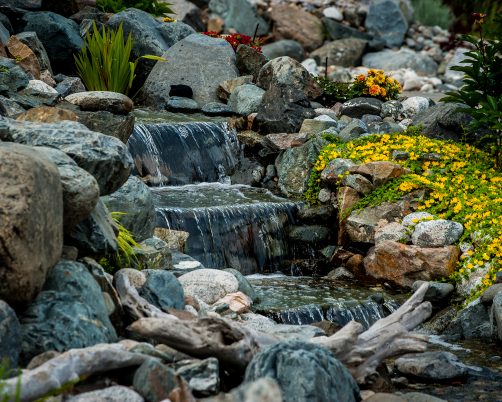
- Pondless waterfalls and streams. Water tumbles over a spillway and through a streambed, then vanishes into an underground basin and recirculates. All the movement and sound of a creek, none of the standing water.
- Architectural and formal fountains. Cleaner lines, geometric basins, spillways set into walls. These suit a more contemporary or structured design.
- Ponds. Still or moving, planted or stocked with fish. The most involved option, and the one that asks the most back from you in care, but for the right yard, nothing else comes close.
Most of what we build leans toward the pondless and naturalistic end, because it fits how people use their yards here: lots of sound and movement, less maintenance, no safety worry with young kids. But the right answer depends on your space and how hands-on you want to be.
What drives the cost
Two water features can be priced thousands of dollars apart, and it usually comes down to a handful of factors:
Size and scale. The single biggest lever. A longer stream, a taller waterfall, and a bigger reservoir all mean more stone, more excavation, and a larger pump.
Stone and materials. Natural boulders and quality stone cost more to handle and deliver than manufactured alternatives, and they make a big difference in how natural the finished feature looks.
Grade and excavation. Kamloops yards come with slope, clay, and rock. A site that drains well and has easy access costs less to work than one that fights you, which is the same story as any landscape build here.
Plumbing and electrical. Pumps need power, and that often means trenching and a proper outdoor electrical connection. More spill points and features add complexity.
Lighting. Underwater and landscape lighting turns a water feature into something you enjoy after dark, which in summer is when you’re most likely out there. It’s an add, but a worthwhile one.
Fish and filtration. The moment a pond holds fish, it needs real filtration, and that raises both the build cost and the ongoing care.
What it costs: three tiers
The ranges below are for the water feature itself. Most of the time a waterscape is one element of a larger landscape project, so read these as the cost of that element within a bigger overall budget.
The accent feature: roughly $6,000 to $15,000. A bubbling boulder, an urn fountain, or a compact pondless spillway, set into a planting bed, beside a patio, or near the front entry. Self-contained or fed by a small hidden reservoir. You get the sound and the movement and a clear focal point, without giving up much of the yard. This is the most popular starting point, especially for front yards and smaller lots.
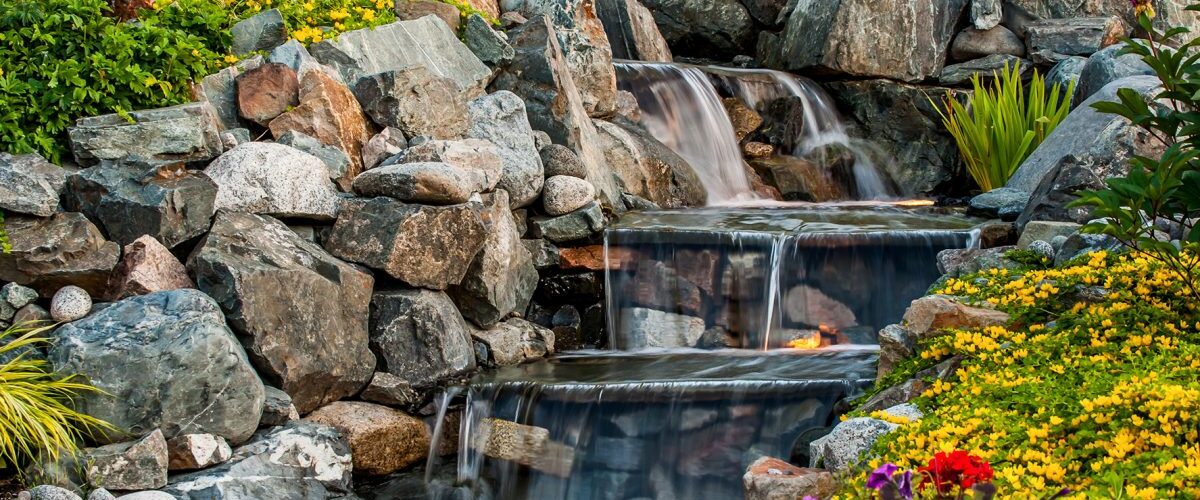
The signature waterscape: roughly $15,000 to $40,000. A proper pondless waterfall with a short naturalistic stream, multiple spill points, real stone, a larger pump, and integrated lighting. This is where the craftsmanship shows: the rock placement, the way the water moves, the hidden liner edges that make the whole thing look like it was always there. It becomes the centre of gravity for the backyard.
The centrepiece: $40,000 and up. A large naturalistic stream-and-pond system, a koi-capable pond with full filtration, or a multi-zone water feature woven through an entire backyard build. Usually designed alongside the hardscape, lighting, and planting as one integrated project. At this level, the water becomes the thing the whole yard is built around.
The part people forget: running it
The build is the number everyone asks about. The running cost is the one that’s easy to overlook, so here’s what to plan for.
A modern, properly sized pump is more efficient than people expect, and the day-to-day power draw is modest. You’ll top up water occasionally to cover evaporation, more often in the heat of a Kamloops July, but it’s not a meaningful hit to the water bill on a well-built recirculating feature.
The real seasonal task is winter. Our freeze is real, and a water feature needs to be shut down and winterized properly each fall to protect the pump and the plumbing, then brought back to life in spring. A pondless feature is simpler on this front than a stocked pond. Beyond that, expect some routine upkeep: clearing debris, the occasional filter clean, keeping algae in check. A pond with fish asks the most; a bubbling boulder asks the least.
None of this is onerous, but we’d rather you hear it from us now than discover it in October.
What you’re actually paying for
It’s fair to ask whether a water feature is just an expensive luxury. We’d push back on that.
The most underrated one is sound. Running water covers the things you don’t want to hear: traffic, a neighbour’s air conditioner, the general hum of a summer evening. It changes the feel of a backyard more than you’d expect until you’ve sat next to one.
Then there’s the pull of it. A well-placed waterscape becomes the thing your eye goes to and the spot people gather around. It draws birds. On a hot day, the moving water and the planting around it make a cooler, more comfortable pocket to sit in. And like the rest of a good landscape, the return on it is daily: it’s the part of the yard you keep coming back to on a summer evening.
That kind of payoff is hard to put a number on. It’s also the main reason people tell us they wish they’d done it sooner.
How we approach waterscapes
The water features that hold up are the ones planned into the yard from the start. When we design a waterscape, we’re thinking about how it sits with the grade, where the sound will carry, how it reads from the kitchen window, and how it ties into the planting and the lighting. The pump, the reservoir, the plumbing, and the liner edges all do their work out of sight.
That’s also why it’s usually best to bring a water feature into the conversation early, as part of the larger landscape design, rather than trying to retrofit one later. If you want to see how this comes together in real yards, our project gallery is the best place to start.
The bottom line
A backyard waterscape in Kamloops can be a modest accent or the centrepiece of the whole yard, and the cost follows that range. What doesn’t change is the value of getting it designed in properly: matched to your site, built to last through our winters, and placed where you’ll actually feel it.
If a bit of running water is the thing your yard has been missing, the best time to plan it in is before the rest of the design is locked.
Frequently asked questions
What’s the most affordable way to get the sound of running water?
A bubbling boulder or an urn fountain. They’re compact, self-contained or close to it, and they deliver the sound and movement of a larger feature at the lowest entry point. They’re a popular first water feature for exactly that reason.
Do you install waterscapes on their own, or only as part of a larger project?
Water features are usually designed as one element of a larger landscape project, which is also where our design-led process fits best. We do take on standalone feature installs in some cases, though the same project minimums that apply to the rest of our work apply here too. The first step is a quick conversation about scope.
Will a water feature run up my power and water bills?
Less than most people assume. A correctly sized modern pump is efficient, and a recirculating feature only needs occasional topping up for evaporation. You’ll notice it more in a hot July than the rest of the year, but it isn’t a significant ongoing cost on a well-built feature.
Do water features attract mosquitoes?
Moving water generally doesn’t, because mosquitoes need still water to breed. Pondless waterfalls and fountains keep the water circulating, which makes them a poor place for mosquitoes to settle. Standing-water ponds need a bit more attention, and there are simple, established ways to manage it.
What happens to a waterscape in winter?
It gets shut down and winterized in the fall to protect the pump and plumbing through the freeze, then restarted in spring. Pondless features are straightforward to put to bed; stocked ponds take more care. We walk you through the routine, or handle the seasonal side through a trusted local crew.
Do you install waterscapes outside of Kamloops?
We do. Alongside Kamloops and neighbouring communities like Aberdeen, Sahali, Juniper, and Dallas, we take on projects out at Nicola Lake, Glimpse Lake, and across the surrounding region, depending on scope.
Ready to get started?
Request a quote and our design team will be in touch within one business day.
Sirocco Landscapes designs and installs residential landscapes throughout Kamloops, BC. Explore our full range of services or browse the project gallery to see recent work.
More Articles
-
 September 24, 2026
Getting a Kamloops Yard Ready for Winter: What to Do Before the First Hard Freeze
By the third week of September the mornings in the valley have an edge to them, the sprinklers are still ...
Read Article -
September 14, 2026
Pond, Pondless Waterfall, or Fountain? Choosing a Water Feature for Your Kamloops Yard
“Pond experts near me.” It is one of the searches that brings people to us, and it tells you something: ...
Read Article -
July 24, 2026
Hardscaping in Kamloops: Patios, Walls, and Walkways That Actually Hold Up
Take a walk through an older Kamloops neighbourhood in early spring and you can read the winters in the hardscape. ...
Read Article