Permeable Pavers in Kamloops: Two Systems and Where Each One Makes Sense
Most plans for a Kamloops yard come with a list. A wider driveway, a paver patio out back, maybe a pool with a deck around it. What is easy to miss is that the City caps how much of a residential lot can be covered in surfaces that shed water, and on a tighter lot that list can run into the limit before the plan is finished.
Permeable paving is one of the best ways we have to make room, and it cuts down the black ice that forms at the bottom of so many Kamloops driveways. The catch is that “permeable” covers two different systems. They look the same from the top. Underneath, one sends water into the ground and the other carries it away, and choosing the wrong one can cost you the benefit you wanted or put water where it does damage.
We think permeable paving is where residential work is heading. Here is how the surface works, how the two systems differ, where each one belongs, and what both of them ask of you.
What makes a paver permeable
The pavers are solid concrete, the same as any other. The difference is in the joints. Permeable pavers have spacers moulded into their sides that hold each joint open wider than a standard paver joint, so water can drop through the surface into the base below. For driveways we particularly like Belgard’s Aqualine permeable paver.
The traditional fill for those joints is loose clear stone. We prefer a permeable jointing compound that hardens in place but still lets water through, and our go-to products are Techniseal Storm, Azpects EASYJoint and Romex’s Rompox Easy. A hardened joint gives a cleaner finish, helps keep weeds out, and can last up to ten years. It costs more up front, and it takes most of the upkeep out of the system.
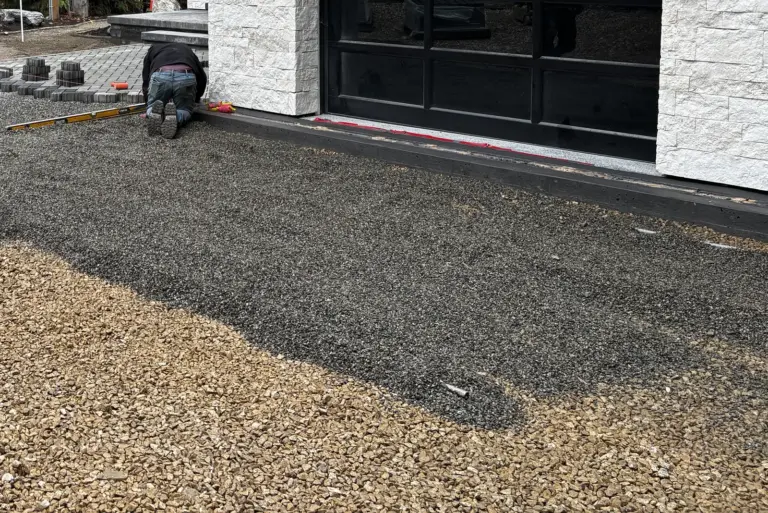
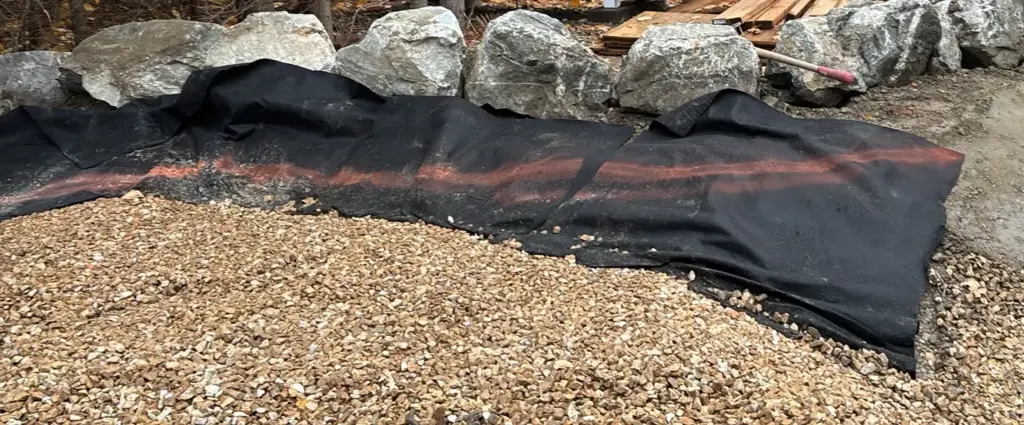
Underneath is the same kind of open-graded base we build under all of our pavers, which we described in our article on hardscaping in Kamloops: 8 to 16 inches of compacted, three-quarter-inch clear crush, depending on the site, topped with a bedding layer of ASTM No. 9 stone, also known as high-performance bedding. Because the base has no fine particles in it, the gaps between the stones hold water until it can move on. Depending on the site, we also lay a woven or non-woven geotextile between the native soil and the base, so fine soil cannot migrate up into the system.
A standard paver surface still sheds most of its water across the top. A permeable one takes it in through the joints. What happens to the water after that is what separates the two systems.
Two systems that look the same from the top
The first is a fully permeable system, which is what we aim to install wherever site conditions allow. The second is a permeable system with subsurface drainage, for places where water soaking into the ground could cause problems. They use the same pavers and jointing products, and both have their benefits, but they suit different sites.
| Fully permeable | Permeable with subsurface drainage | |
|---|---|---|
| Where the water goes | Through the base and into the soil below | Through the base, then collected by a drainage system and directed away |
| Best suited to | Open areas on soil that can take the water | Next to a pool, a house foundation, a retaining wall or anything else water could damage; soil that drains slowly or should stay dry |
| What is underneath | Open-graded base | Open-graded base plus a drainage system, with a liner where needed |
| Lot coverage limit | Can be counted differently | A lined system counts the same as standard paving |
Fully permeable: more room to build
In a fully permeable system, water passes through the surface and the base and soaks into the soil underneath. There is no pipe to run and no outlet to find, and the water stays on your property. On sandy, gravelly soil that drains quickly, it is also the simplest version to build.
It is also where the biggest benefit of permeable paving comes from: how much of your property it lets you use. Kamloops limits how much of a residential lot can be covered in surfaces that shed water. Roofs count toward that limit, and so do asphalt, concrete, standard pavers and most gravel. A permeable surface that lets water soak into the ground can be counted differently, provided the product and the way it is built meet the City’s requirements.
That is where the room comes from. Say the plan is a new driveway, a paver patio out back and a deck around a pool. Built conventionally, all three count against the limit. Make the driveway fully permeable and it can stop counting, which can be what keeps the patio and the pool deck in the plan. On a large lot with a modest house the limit may never come into play. On a smaller lot, or one that already carries a big house, it can decide what else fits, so it is worth knowing where your property stands before anything is designed.
Permeable with subsurface drainage: keeping water away from structures
A fully permeable system does not work in every application. Water soaking into the ground is what you do not want next to a pool foundation, a house foundation, a retaining wall or anything else water could damage. We can still use the same permeable pavers and jointing products in those places, with a drainage system underneath that collects the water and directs it away.
How that drainage is built depends on the site. On slower soil, including the clay under much of the valley floor, a perforated drain pipe in the base can carry off whatever the soil cannot absorb in time. Canadian design guidance draws the line at soil that takes in less than about 15 millimetres of water an hour; below that, the base gets a pipe.
Where water should not reach the ground at all, the system sits on an impermeable liner and drains entirely by pipe. Around pools, where water is concentrated, a lined system is what we use. On one pool deck we built, the liner was sloped toward a buried corrugated drain that carries the water out to daylight, away from the pool.
The surface works the same way in both systems, so water goes down through the joints instead of across the top, and meltwater still drains away in winter. The trade-off is lot coverage. Because none of the water soaks in, a lined system counts the same as standard paving toward the limit.
Permeable and standard paving, together
A project does not have to be all one or the other. Sometimes we combine standard and permeable paving on the same surface to build a hidden drainage system. The permeable section collects surface water and sends it underground, where it is redirected, so the patio or driveway does not need a visible channel drain cutting across it. It is a technique we specialize in, and as far as we know, no other contractor in Kamloops uses it this way.
Which system your site needs
There is no one-size-fits-all permeable system. We assess every installation on its own: the soil, the drainage, the structures around it and what you want the space to do. The priority is making sure water does not compromise the pavers, a retaining wall, a foundation or anything else on the property. That is as much earthworks and design as it is paving, which is why both come first in our process.
Soil is the first question, and Kamloops has a bit of everything. Some ground should not have water sent into it at all, such as loose fill or soil that becomes unstable when it is soaked. The silt benches along the South Thompson in eastern Kamloops are the best-known example: they are the floor of an ancient glacial lake, and that silt can develop sinkholes and underground tunnels when water concentrates in it. Some hillsides are sensitive to added groundwater too. On sites like these a permeable surface is built lined and piped.
The house is the next question. The base should drain away from it, and design guidance recommends keeping an infiltrating surface about four metres downhill of a foundation if it also takes runoff from a roof or other paving, or protecting the foundation when it has to be closer.
Slope comes after that. Permeable paving is simplest on grades up to about 5%. On anything steeper, water runs downhill through the base and arrives at the bottom all at once, so the base is broken into steps with buried check dams that hold it back. A lot of hillside driveways in Sahali, Aberdeen and Juniper are steeper than that, and they can still be built permeable. They take more design and more base work.
One property can use both systems: a fully permeable driveway out front that helps with lot coverage, and a lined system around the pool at the back. You can see more of our paving, walls and stonework on our hardscaping page.
How both systems handle a Kamloops winter
Anyone who has spent a winter here knows the patch. The sun clears the top of the driveway by early afternoon, the meltwater runs downhill, and by the time you get home after dark it has frozen into a sheet of clear ice at the bottom. Our winters freeze and thaw constantly, and on a solid surface the water melted during the day is still lying there when the temperature falls. On a permeable one, most of it has already gone down through the joints.
That difference has been measured. Researchers from the University of Toronto spent two winters testing permeable pavers alongside an asphalt surface at the Kortright Centre in Vaughan, Ontario. After sunset, melted snow and ice refroze into black ice on the asphalt but not on the permeable pavers. Being darker, the asphalt melted snow faster; what mattered was where the water went once it melted. The same study found that in mild winter conditions the pavers could be salted at half the usual rate and stay just as safe. The test pavers had stone-filled joints and sat over slow-draining soil with a drain pipe in the base, so the result does not depend on the ground taking all of the water.
Frost is the other worry people raise, and it is one reason permeable paving was slow to catch on in cold places. Frost damage comes from water that is trapped under a surface and freezes, and an open-graded base drains instead of staying saturated. In a two-winter study at the University of New Hampshire, a permeable paver road on campus was plowed with a steel-edged blade through repeated freeze-thaw cycles, and not a single paver was dislodged.
How permeable pavers compare with other driveway surfaces
| Where the water goes | In winter | Upkeep | |
|---|---|---|---|
| Asphalt | Runs off to the lowest point | Meltwater can refreeze as black ice | Sealing and crack repair |
| Poured concrete | Runs off to the lowest point | Same refreeze risk, and salt is hard on it | Cracked slabs are cut out and replaced |
| Standard pavers | Mostly runs off across the surface | Same refreeze risk where water collects | Joint top-ups; pavers can be lifted and reset |
| Permeable pavers | Down through the joints into the base | Meltwater drains away instead of refreezing | Light with hardened joints; keep sand and soil off |
| Gravel | Some soaks in; packed gravel sheds much of it | Harder to clear cleanly | Raking, regrading and topping up |
Gravel lets some water through, but once tires have packed it down it sheds a good share of it, which is why most gravel still counts toward the lot coverage limit.
The upkeep
The surface is the same in both systems, so the upkeep is too. Clogging is what slows a permeable surface down. Grit off tires, dust, leaves, soil washed out of a garden bed and winter sand all settle into the joints over time.
How much work that means depends on what is in the joints. Loose clear stone, the usual choice on commercial lots, needs vacuuming and topping up to keep it open. All of our work is residential, and the hardened permeable joints we use hold together and keep weeds out, so they ask far less of you.
What it does need is a few habits:
- Skip the sand. On most patios and walkways we would reach for sand before salt, as we suggested in our checklist for getting a yard ready for winter. A permeable surface is the exception, because sand settles into the joints and slows the water down. A study of permeable pavers in Calgary found the surface took in water significantly more slowly after a winter of sanding and de-icing.
- Go easy on the salt, and read the label. You will need less than you would on asphalt. Rock salt, calcium chloride and potassium chloride are all acceptable on concrete pavers in modest amounts. Avoid magnesium chloride, which the Concrete Masonry and Hardscapes Association’s maintenance guidance warns will eventually break down concrete.
- Keep soil and mulch off it. Garden beds should not drain across the paving, and landscape deliveries should not be dumped on it. If the snow you clear is gritty, push it onto the lawn rather than leaving it to melt on the pavers.
- Sweep it now and then, so leaves and grit do not sit in the joints.
- Clear snow as usual. Shovel, snowblow or plow it like any other driveway. A plastic or rubber edge is kinder to the surface than steel.
What it costs, and when it is worth it
A permeable surface costs more to build than a standard paver surface. The pavers are a specialized product and the hardened joints we prefer cost more than loose stone. Subsurface drainage, a liner or a stepped base on a slope add more again.
A fully permeable system makes its strongest case on a tight lot, where it is what lets the rest of the plan fit. A system with subsurface drainage earns its cost by protecting what sits next to it, since a pool, a foundation or a retaining wall costs far more to repair than drainage does to install. Either one also earns its keep where water is already a problem, such as a driveway that ices over at the bottom every winter or one that sends runoff toward the garage, and for anyone replacing a driveway anyway, since the excavation is happening regardless.
It is not the answer for every project. Where gritty runoff from an unpaved area drains onto the surface, the joints will clog faster than they should, and on a very steep driveway the stepped base can cost more than the benefit is worth.
The bottom line
Permeable paving takes water in instead of shedding it, and the surface is the same either way. A fully permeable system lets the ground take that water, and on a tight lot it can free up room for the patio or pool deck you want. A system with subsurface drainage carries the water away from anything it could damage. Both cut down the ice at the bottom of the drive, and with hardened permeable joints the upkeep on either one is light. On the right site, we think it is the best paving you can put in here.
Frequently asked questions
What is the difference between a fully permeable system and one with subsurface drainage?
A fully permeable system lets water pass through the surface and base and soak into the soil below. A system with subsurface drainage uses the same pavers and jointing products, with a drainage system underneath that collects the water and directs it away, sometimes over a liner. We aim for fully permeable wherever the site allows, and use subsurface drainage where water soaking in could damage a pool, a foundation, a retaining wall or another structure.
Do permeable pavers work in a Kamloops winter?
Yes, and they help with ice, with either system. In a two-winter University of New Hampshire study, plowing and freeze-thaw did not dislodge a single paver. In a University of Toronto study, melted snow refroze into black ice on asphalt after sunset but not on permeable pavers, because the meltwater had already drained away. Snow still has to be cleared, as on any other surface.
Can I use salt or sand on permeable pavers?
Salt, sparingly. Sand, no: it settles into the joints and slows the water down. Rock salt, calcium chloride and potassium chloride are acceptable in modest amounts, and permeable pavers generally need less than asphalt does. Avoid magnesium chloride, which damages concrete over time.
How do you maintain permeable pavers?
With the hardened permeable joints we use, not much. Keep sand, soil and mulch off them, sweep now and then, and go easy on the salt. Loose stone joints, more common on commercial lots, need periodic vacuuming and topping up, which is one reason we prefer hardened joints for homes.
Will permeable pavers work on clay soil?
Yes, with a drain pipe in the base, which makes it a system with subsurface drainage rather than a fully permeable one. On clay that absorbs water slowly, the pipe carries off what the soil cannot take in, so the base does not sit full.
Can a sloped driveway be permeable?
Yes. Up to about a 5% grade the design is straightforward. Steeper driveways need buried check dams in the base to stop water running downhill through the stone and collecting at the bottom. That adds cost, so on a very steep driveway we will talk through whether it is worth it for your site.
Can permeable pavers go around a pool?
Yes. Around a pool, where water is concentrated, we build the permeable surface over a liner that slopes to a buried drain, which carries the water to daylight away from the pool. The deck drains through its surface like any permeable paving, but because the water does not soak into the ground, a lined deck counts the same as standard paving toward the lot coverage limit.
Can permeable and regular pavers be combined?
Yes. Sometimes we combine the two on one surface to build a hidden drainage system: the permeable section collects surface water and sends it underground, so the patio or driveway does not need a visible channel drain. It is a technique we specialize in.
Will permeable pavers lower my property taxes in Kamloops?
No, not currently. Kamloops pays for storm drainage out of general property taxes, and there is no separate charge tied to how much of your lot is paved. Some Canadian cities already reward permeable surfaces: Victoria and Kitchener both charge a stormwater fee based on a property’s impervious area and offer credits for permeable paving, and we think more municipalities will follow. For now, the benefit is more usable space on the same lot.
Are permeable pavers more expensive than regular pavers?
Generally, yes. The pavers and the hardened joints we prefer both cost more than their standard equivalents, and sites that need subsurface drainage or a stepped base on a slope cost more again. What you get for it is a surface that handles water and ice differently and, on a tight lot, room for the rest of the project.
Can permeable pavers handle cars and trucks?
Yes. Pavers for a driveway are at least 80 millimetres thick, and the base is built for vehicle loads. Permeable paving is not meant for constant heavy truck traffic, but family cars and pickups are well within what a residential driveway is designed to carry.
Ready to get started?
If you are planning a driveway, patio or pool deck, our online estimator gives you a starting range in a couple of minutes. When you want to talk through your site, request a quote and our design team will be in touch within one business day.
Sirocco Landscapes designs and installs residential landscapes throughout Kamloops, BC. Explore our full range of services or browse the project gallery to see recent work.
More Articles
-
 September 24, 2026
Getting a Kamloops Yard Ready for Winter: What to Do Before the First Hard Freeze
By the third week of September the mornings in the valley have an edge to them, the sprinklers are still ...
Read Article -
September 14, 2026
Pond, Pondless Waterfall, or Fountain? Choosing a Water Feature for Your Kamloops Yard
“Pond experts near me.” It is one of the searches that brings people to us, and it tells you something: ...
Read Article -
July 24, 2026
Hardscaping in Kamloops: Patios, Walls, and Walkways That Actually Hold Up
Take a walk through an older Kamloops neighbourhood in early spring and you can read the winters in the hardscape. ...
Read Article