Pond, Pondless Waterfall, or Fountain? Choosing a Water Feature for Your Kamloops Yard
“Pond experts near me.” It is one of the searches that brings people to us, and it tells you something: by the time most homeowners start looking, they have already decided they want water in the yard. What they have not decided is which kind. And the word “pond” is doing a lot of quiet work in that search, because half the people typing it do not actually want a pond.
A water feature can mean a still, planted pond, a waterfall that tumbles over stone and vanishes into gravel, or a simple bubbling urn beside a patio. They look related, but they ask very different things of your yard, your time, and your water bill. Here is how we help Kamloops homeowners choose.
The three families of water feature
A pond is a standing, planted body of water: a contained ecosystem of aquatic plants that draws wildlife into the yard, and can hold fish if you decide to keep them. It is the most alive of the three options, and also the most involved, because a living system needs filtration, seasonal care, and a bit of ongoing attention.
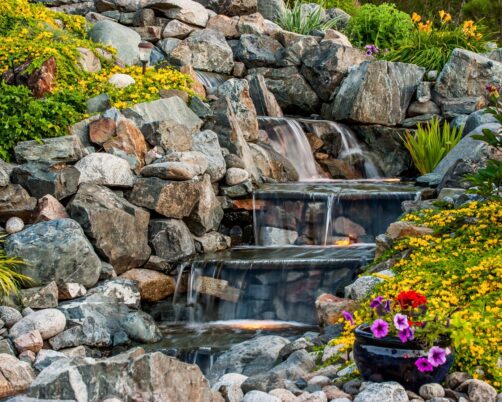
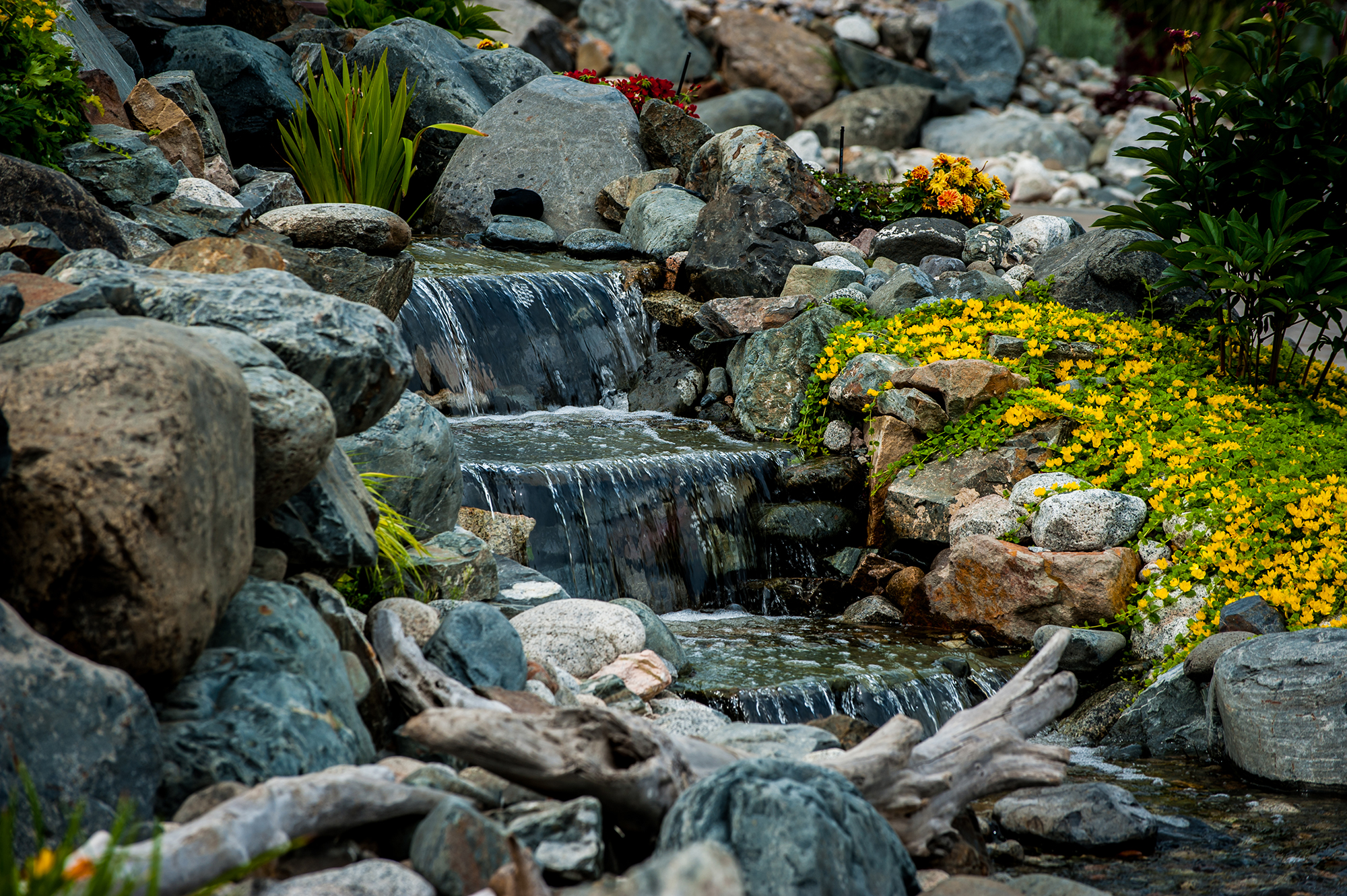
A pondless waterfall or stream gives you moving water, the sound and the motion, with no open pool. The water recirculates from a hidden underground reservoir, so it disappears into gravel at the bottom and pumps back up to the top. No standing water means less maintenance and nothing for a child to fall into.
A fountain or urn is the smallest commitment: a self-contained recirculating feature that brings the sound of water to a patio or entry without excavation or a large footprint. It is the easiest way to test whether you love having water in the yard before committing to something larger.
The first real question: do you want the pond, or the sound of water?
This is where most decisions are actually made. If the picture in your head is a still pond planted with lilies and reeds, a small ecosystem to tend, you want a pond, and everything that comes with keeping one healthy. If what you are really after is the sound of running water on a warm evening and the movement it brings to a space, a pondless waterfall gives you nearly all of that for less upkeep and less risk.
Here is how the three compare on the things that tend to decide it:
| Pond | Pondless waterfall | Fountain or urn | |
|---|---|---|---|
| Standing water | Yes | No | Minimal |
| Planted ecosystem | Yes | No | No |
| Maintenance | Higher | Lower | Lowest |
| Child and pet safety | Needs planning | Very safe | Very safe |
| Space needed | More | Flexible | Minimal |
| Relative cost | Highest | Middle | Lowest |
None of these is the “right” answer on its own. They are matched to how you want to use the yard, who is in it, and how much upkeep you want to sign up for.
The water-wise question every Kamloops yard should ask
People sometimes hesitate at the idea of a water feature in a city that spends its summers under watering restrictions. It is a fair question, and the answer usually surprises them: a well-built water feature uses far less water than the lawn it might replace.
The reason is recirculation. A pondless waterfall or a fountain does not consume water as it runs; the same water cycles through, hour after hour, and the only real loss is evaporation, which gets topped up automatically. A recirculating feature and a section of thirsty turf are not in the same league on water use. Set beside a heavily irrigated lawn, the feature is the water-wise choice, which is the same logic behind the water-conscious planting we cover in our piece on xeriscape and softscape in Kamloops. Water that used to keep grass alive can instead run a feature you actually notice and enjoy.
What holds a water feature together
The water and stone are the part you notice. What decides whether a feature still runs cleanly in ten years is the system underneath, and most of the real work goes there.
The reservoir and liner. What holds the water depends on the feature. For streams and ponds we use HDPE pond liner. For a pondless waterfall the hidden reservoir is built from Aquascape AquaBlocs, a modular block system that banks far more water beneath the gravel than loose stone could in the same space, and smaller features can run off a simple tub-style reservoir. Whatever the method, it has to hold enough that the feature never runs itself dry, and it has to be set up so the level can be kept full.
The pump, the plumbing, and the sound. A pump moves water from the reservoir back to the top of the feature, and its flow is what tunes how the water behaves. We custom-design every feature with our suppliers around three things at once: how it looks, how the water moves, and how it sounds. That last part has a name, soundscaping. The same footprint can be set to a soft, meditative trickle or a rushing-river rush loud enough to cover traffic and other background noise from beyond the yard.
Filtration and clarity. We build ecosystem ponds planted with a range of aquatics, and every treatment we use is safe for fish and wildlife. On our larger features we have moved to Aquascape’s automatic dosing system, a plug-and-play unit the homeowner runs from an app, which keeps the water clean without a hands-on chemical routine.
Water, power, and the auto-fill. Kamloops has excellent, relatively soft water, which is easy on pumps and one less thing to fight. Every feature also needs a dedicated, GFCI-protected power supply run out to the pump. The detail that quietly protects the whole system is an automatic fill: we tie the feature into its own irrigation zone with an auto-fill valve, so as water evaporates the level tops up on its own. That keeps the pump from ever running dry and burning out, which is the most common way a feature dies young.
Water features and a real Kamloops winter
Water plus freeze-thaw is the exact combination that wears out a poorly built feature, and Kamloops delivers plenty of both. Our approach is straightforward: we shut the features down for the season and set them up to ride out the cold safely.
The pump is the part that matters most. If it sits in at least two feet of water, it can stay right where it is over winter, and submerged is actually where it does best, since being underwater prevents corrosion. On shallower features we pull the pump and overwinter it in a bucket of pond water, somewhere it will not freeze. The feature itself is drained down and left to rest until spring.
The rest of what makes winter a non-event is unglamorous and built in from the start: plumbing set below frost, drain points and valves where they need to be, and construction that expects the ground to move. A feature built for our climate treats winter as a season to wait out, not a problem to survive.
Matching the feature to the yard
Once the type is settled, placement is what makes a feature feel built-in rather than added on. A few things we think about on every Kamloops project:
- Sound and where you sit. Water is an audio feature as much as a visual one. We place it within earshot of where you actually spend time and tune the flow to match: a quiet backdrop beside a morning-coffee bench, or something with more rush where you want to mask a busy road.
- Sightlines. A feature should be visible from inside the house, not just from the far corner of the yard. Winter is long here, and a feature you can see from the couch earns its keep in the months you are not outside.
- Grade and stone. Kamloops slope is an asset with water. A natural drop lets a stream or waterfall follow the land instead of fighting it, and local stone keeps it looking like it belongs in the Thompson Valley rather than shipped in from somewhere else.
- Safety and stage of life. For families with young kids or dogs, a pondless design removes the standing-water worry entirely, which is often what tips the decision.
How we approach waterscapes
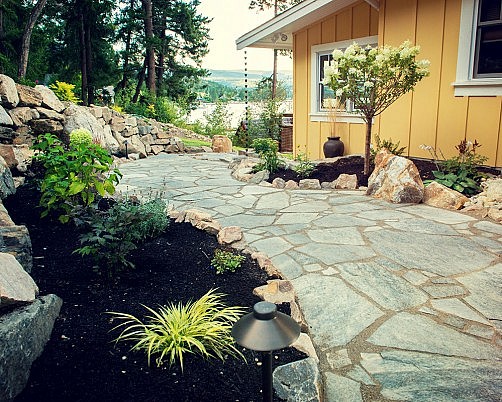
We design water features as part of the whole landscape, not an object set down on the lawn, and we custom-build each one with our suppliers rather than dropping in a kit. The feature ties into the grade, the planting, the patio, and the lighting. Most of all, it is built to look like it belongs: the right stones chosen and set, the flow shaped to the space, driftwood, moss, and plants worked in until the whole thing reads as though it was always part of the property. The installation carries a one-year workmanship warranty, and the Aquascape pumps we fit come with a three-year manufacturer warranty.
You can see the range on our waterscapes page and in the project gallery. If you have landed on the type you want and are now wondering about budget, our companion article on what a backyard waterscape actually costs in Kamloops breaks down the tiers.
The bottom line
Anyone can make water move. The harder part, the part that takes experience and a good eye, is making a feature look like it was always there rather than something recently dropped in. Choosing one starts with a single question worth answering plainly: do you want a small ecosystem to tend, or simply moving water in your life? The rest, size, placement, and stone, follows from there. For most Kamloops yards a recirculating waterfall or stream is the sweet spot: the sound and the movement, low upkeep, safe for the whole household, and gentler on water than the lawn it stands in for. Either way, most of what makes it last sits under the surface, which is where we spend our attention.
Frequently asked questions
What is the difference between a pond and a pondless waterfall?
A pond is a standing, planted body of water that needs filtration and seasonal care. A pondless waterfall gives you moving water, the sound and the look, with no open pool: the water recirculates from a hidden underground reservoir. Pondless designs need less maintenance and remove the standing-water safety concern, which is why they are a popular choice for families.
Which water feature needs the least maintenance?
A fountain or urn is the lowest-maintenance option, followed closely by a pondless waterfall, which mostly needs the occasional pump rinse and debris clean-out. A pond asks the most, since a planted ecosystem needs filtration, water treatment, and seasonal start-up and shut-down. If low upkeep is the priority, a recirculating pondless feature is usually the right call.
Do water features waste water during Kamloops water restrictions?
A properly built water feature recirculates the same water rather than consuming it, so the only real loss is evaporation, which an automatic fill valve tops up as needed. In practice a recirculating feature uses far less water than an irrigated lawn of similar footprint. It is one of the more water-wise things you can add to a yard in a dry climate like ours.
How do you winterize a water feature for a Kamloops winter?
We shut features down for the season. If the pump sits in at least two feet of water it can stay submerged over winter, which actually protects it, since being underwater prevents corrosion. On shallower features we remove the pump and store it in a bucket of pond water somewhere it will not freeze. The feature is drained down and rests until spring, then comes back to life when we start it up again.
Do you handle fish or koi ponds?
We build planted ecosystem ponds, and every treatment we use is safe for fish and wildlife, but we do not handle fish stocking or koi care ourselves. A pond we build can certainly hold fish you add and look after, or bring in a fish specialist for. The water feature, the ecosystem, and the planting are what we design, build, and stand behind.
How do you keep pond water clear without heavy chemicals?
Clear water comes mostly from biology, not chemistry. Aquatic plants compete with algae for nutrients, and on larger ponds we use Aquascape’s automatic dosing system, controlled from an app, to keep the water clean with treatments that are safe for fish and wildlife. Balanced well, a pond stays clear largely on its own, with light seasonal maintenance rather than a constant chemical routine.
Are ponds safe with young kids?
A pond has standing water, so it needs to be planned with safety in mind if young children or dogs use the yard. For households where that is a concern, a pondless waterfall is the common recommendation, because the water disappears into a hidden reservoir and there is no open pool to fall into. You still get the sound and movement, without the worry.
Can I add a water feature to a yard that is already finished?
Often, yes. Fountains and compact pondless features can frequently be worked into an existing yard with minimal disruption. Larger streams and ponds are easier and cheaper to build into a broader landscape plan, since they tie into grade, drainage, and planting, but a good design can still retrofit one thoughtfully. The best time to add water is during a larger project; the second-best time is now.
Do you build water features outside Kamloops?
Yes. In addition to projects throughout Kamloops, we take on select waterscape projects in surrounding areas, including Nicola Lake, Glimpse Lake, Logan Lake, Chase, the Shuswap, and other nearby communities, depending on the size and scope of the project.
Ready to get started?
If you want a ballpark before you talk to anyone, our online estimator gives you a starting range in a couple of minutes. When you are ready to get into specifics, request a quote and our design team will be in touch within one business day.
Sirocco Landscapes designs and installs residential landscapes throughout Kamloops, BC. Explore our full range of services or browse the project gallery to see recent work.
More Articles
-
 September 24, 2026
Getting a Kamloops Yard Ready for Winter: What to Do Before the First Hard Freeze
By the third week of September the mornings in the valley have an edge to them, the sprinklers are still ...
Read Article -
July 24, 2026
Hardscaping in Kamloops: Patios, Walls, and Walkways That Actually Hold Up
Take a walk through an older Kamloops neighbourhood in early spring and you can read the winters in the hardscape. ...
Read Article -
June 23, 2026
What a Backyard Waterscape Actually Costs in Kamloops (And What You Get For It)
There’s a moment that tends to happen on a hot Kamloops evening, usually with a drink in hand on the ...
Read Article