Getting a Kamloops Yard Ready for Winter: What to Do Before the First Hard Freeze
By the third week of September the mornings in the valley have an edge to them, the sprinklers are still running out of habit, and most people have not thought about the yard since August. That is the window. Nearly everything that protects a Kamloops landscape through winter has to happen in the next few weeks, while the ground is still workable and there is still water moving through the lines.
Our winters are not the hardest in the country, but they are hard on landscapes in a specific way. We get a real freeze, we get it in a dry climate that sees roughly 280mm of precipitation in a year, and we get long stretches of bright sun that thaw a south-facing surface in the afternoon and refreeze it overnight. Water that moves, freezes, and moves again is what causes the damage, whether it is sitting in a sprinkler line, in the soil around a young shrub, or in the gravel base under a patio.
Here is the order we would work through it.
The one job with a real deadline
The rest of this list can slip a week or two without much consequence. Irrigation cannot.
Water expands as it freezes. An irrigation system is a network of pipe, valves, fittings and heads with water standing in all of it, and when that water turns to ice it splits whatever is holding it. The costly casualties are usually the backflow preventer, which sits above ground, exposed, and is the priciest single component in most residential systems; the valves in the manifold; and the gears inside the heads, which crack and then weep quietly all next summer until the water bill gives them away.
A blow-out clears the water out with compressed air, zone by zone, before it can freeze in place. It is the single highest-value hour anyone spends on a Kamloops yard in the fall.
What a proper blow-out involves
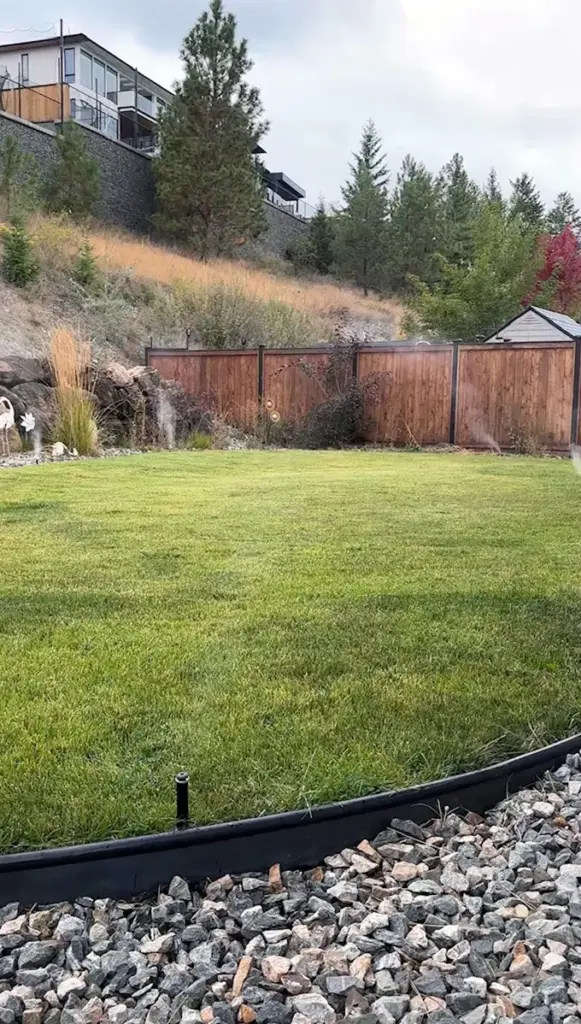
The common instinct is to reach for pressure. What clears a line is air volume, and a typical homeowner compressor delivers plenty of pressure with very little volume behind it. Push too hard and you warp heads, cook seals and damage the gear drives you were trying to protect; move too little air and water stays in the low spots, which is the whole problem you set out to solve.
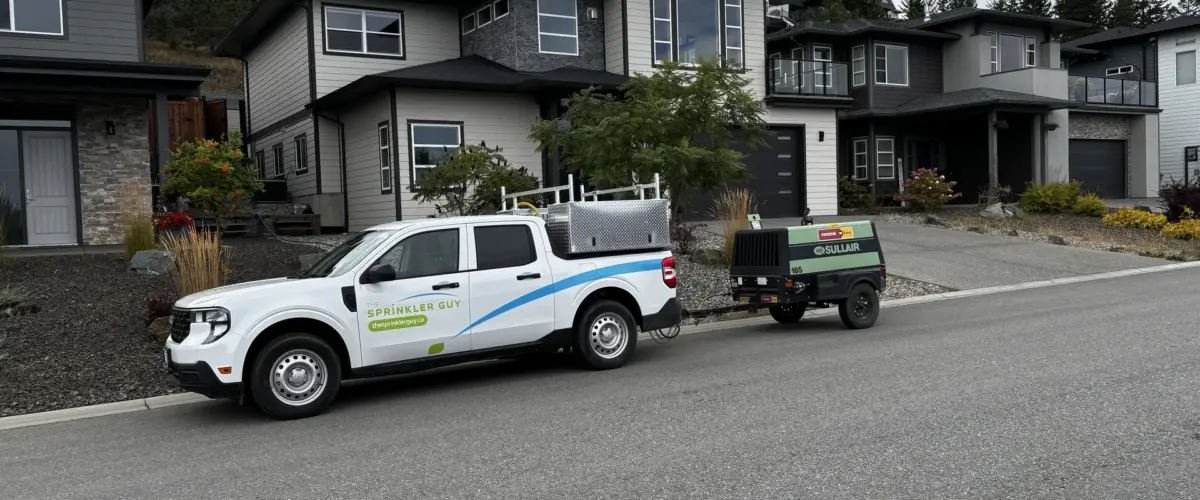
Done properly, the system is cleared zone by zone at a controlled pressure and volume, with valves opened and closed in sequence so every line runs dry, the backflow assembly drained and left in the right position, and the controller shut down for the season. Our irrigation work is handled by our sister company, The Sprinkler Guy, which has been servicing Kamloops systems since 2008. Fall winterizing and spring start-up are a matched pair: the care that empties the system in October is what brings it back in April without a zone full of surprises.
One detail that gets forgotten: shut the controller off rather than leaving it to run its summer schedule. A smart timer that pulls from local weather stations still needs its season ended deliberately, or it will happily fire a zone during a February thaw.
When to book it
As soon as you have stopped watering, and before the first hard freeze. In Kamloops that freeze usually arrives sometime in October, though it has turned up in the last days of September more than once. The practical constraint is not the weather, it is the calendar: everyone in town needs the same two or three weeks, so the schedule fills from late September onward. Booking early costs nothing. Being late can cost a backflow assembly.
A fall order of operations
| Job | Why it matters | |
|---|---|---|
| Late September | Book the irrigation blow-out, stop watering the lawn | The schedule fills fast, and the lines need to be dry before a freeze |
| Late Sept to mid October | Deep-water evergreens and anything planted this year | Frozen ground cannot replace the moisture winter sun and wind take out |
| October | Blow-out done, controller off, hoses drained, outdoor taps closed | Standing water is the thing that breaks equipment |
| October | Cut back what is diseased, leave the healthy stems standing | Seed heads feed birds and catch insulating snow |
| Once the ground cools | Mulch new beds, guard young trunks | Steadier soil temperature, less heaving, no sun scald |
| Before the first snow | Clear drains, swales and downspout outlets, check lighting timers | Water needs somewhere to go during every winter thaw |
| Any time over winter | Design next year’s project | The build season books out long before spring arrives |
Your plants’ first winter
Anything planted this year goes into winter without an established root system, and that is the group worth spending attention on.
Water deeply before freeze-up. This is the step people skip in a dry climate, on the reasoning that the growing season is over. Evergreens keep losing moisture through their needles all winter, and once the ground is frozen the roots cannot replace it. A slow, deep soak of conifers, new trees and new shrubs in the weeks before the ground hardens does more for their survival than anything else on this list. Ponderosa pine and Douglas fir handle our climate on their own once established; in their first season or two they are still getting there.
Mulch after the soil cools, not before. Mulch laid down while the ground is still warm holds that warmth and keeps plants growing when they should be shutting down. Applied later, a few inches over the root zone steadies soil temperature through our freeze and thaw cycles, which is what spares new perennials from being heaved out of the ground over the winter. Keep it off the trunks and stems.
Guard young trunks. Winter sun on the south and southwest side of a thin-barked young tree warms the bark during the day and lets it refreeze after dark, which splits it. A wrap or a white guard for the first few winters prevents that, keeps rodents from chewing at snow level, and in the neighbourhoods where deer wander through, Juniper and Aberdeen and Dallas among them, keeps the browsing down to something the plant survives.
Cut selectively. Anything diseased or mushy should come out now so it is not overwintering in the bed. Healthy perennial stems can stay: they hold snow, which insulates, and they feed birds through the winter. Asters and irises and the rest can be tidied in spring when you can see what made it through.
Stop feeding. Fertilizer late in the season pushes soft new growth that has no chance to harden off before the first freeze.
Drought-tolerant planting is not exempt from any of this in its first year. A xeriscape bed asks very little of you once it is established, and the first winter is the stretch where it gets there. We compared the two approaches in xeriscape or softscape, and the planting side of our work sits on the softscaping page.
What winter does to hardscape
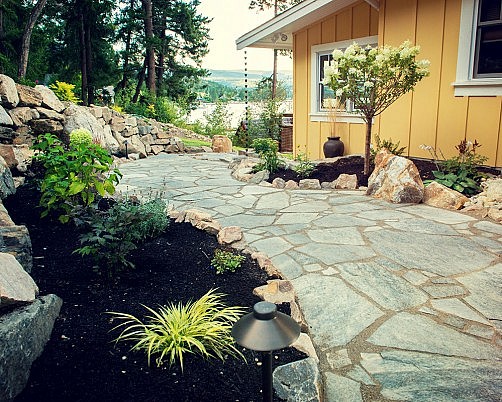
A patio, a walkway or a retaining wall does not fail because of cold. It fails because of water in the base that freezes, expands, lifts the surface a little, and then does it again on the next cycle. Over a few seasons that is what tips pavers out of level and pushes a wall out of plumb. Which base was put down, and how the drainage was set up, decides how well any of it holds, and that work is done long before the first snow. We wrote about what goes under a patio in our piece on hardscaping in Kamloops.
What you can do in the fall is make sure water still has somewhere to go. Clear leaves out of drains, swales and channel grates, and check that the downspouts discharge well away from patios and walls rather than into the base of them.
Then there is ice. Rock salt is hard on concrete, on natural stone, and on whatever is planted beside the walkway once the melt carries it into the soil. Sand gives traction without the chemistry. If you use an ice melter, use it sparingly and pick one rated for the surface, and do not pile salted snow onto planting beds when you clear the drive. A plastic-edged shovel is easier on pavers than a steel one.
Water features, lighting, and the rest of the system
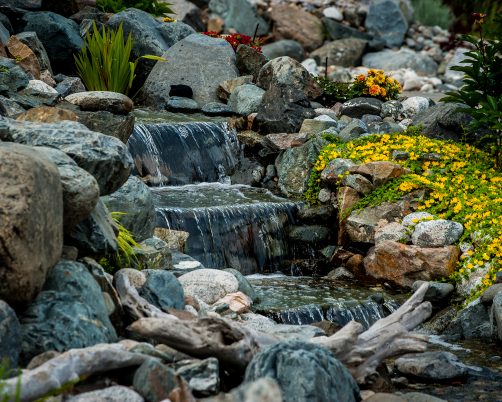
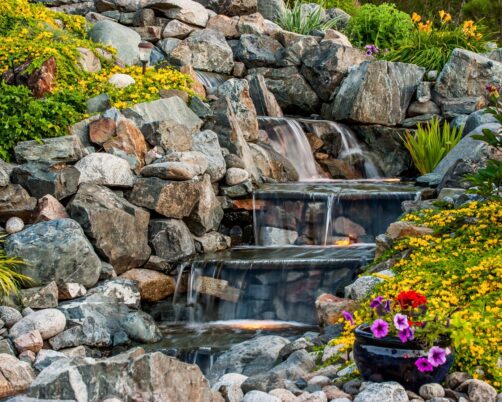
Water features get shut down for the season rather than run through it. If the pump sits in at least two feet of water it can stay submerged, which protects it from corrosion; in a shallower feature it comes out and overwinters in a bucket of pond water somewhere it will not freeze. There is more detail in our article on choosing a water feature.
Landscape lighting earns its keep in the months you are least likely to be outside, so this is the moment to make it work. Days shorten quickly through October and a timer set in June will be switching on an hour late. Walk the yard after dark once this month: check the fixtures before snow covers them, aim anything that has drifted, and keep the heads clear when you shovel. A scheme that looked right in summer foliage often reads differently once the leaves are down.
What can wait until spring
Not everything belongs on the fall list. Most shrub pruning is better done at the end of winter, when the plant is dormant and you can see its structure. Dividing perennials, seeding a lawn and planting anything new are all spring jobs here. Fall is for protecting what is already in the ground and getting the water out of everything that holds it.
Fall is when next year’s yard gets designed
The other thing worth doing in the next few weeks has nothing to do with frost. Winter is when landscape projects get planned, because design takes time and the build season fills up well before it starts. A yard that gets designed in November is a yard that can be built early in the season; a call in April is usually a call about next year. If a project is somewhere on your list, this is the quiet part of the year to think it through. Our page on landscape design covers how we approach that, and our article on what to expect when you start a project walks through the sequence.
The bottom line
Fall work in Kamloops comes down to getting water out of the things that hold it and moisture into the things that need it. Clear the irrigation system before the freeze, soak the evergreens and new plantings while you still can, mulch once the soil cools, keep the drainage paths open, and leave the pruning for spring. None of it takes long. All of it is cheaper than what it prevents.
Frequently asked questions
When should I blow out my sprinklers in Kamloops?
Once you have stopped watering for the season and before the first hard freeze, which usually means through October here, occasionally earlier. The limiting factor is scheduling rather than weather: the whole city needs the service in the same short window, so the calendar fills from late September. If in doubt, book earlier than you think you need to.
Can I blow out my own irrigation system?
You can, but the failure modes are expensive. Clearing a line takes air volume, and most homeowner compressors supply pressure instead, which is the combination that warps heads and blows seals while still leaving water sitting in the low points. If you do it yourself, work zone by zone at a modest pressure and make sure the backflow assembly is drained. If the system is large, or you are not sure where every valve and low point sits, a professional winterizing service costs far less than a cracked backflow preventer.
What happens if I skip the blow-out?
Sometimes nothing, in a mild winter. More often you find out in the spring, when a zone will not hold pressure, a valve weeps, or the backflow assembly has split. The frustrating part is that the damage is usually invisible until start-up, so a system can sit broken for months and then need parts at the busiest time of the year for irrigation work.
It has already frosted. Is it too late?
A light frost is not the same as a hard freeze, and a couple of frosty mornings will not usually damage a system. Get it done promptly rather than waiting for the next window; the risk climbs once overnight temperatures stay below freezing and the ground starts to hold cold.
Do I really need to water before winter in a dry climate?
Yes, especially for evergreens and anything planted in the last year or two. Conifers keep transpiring through the winter, and they cannot draw replacement moisture out of frozen ground. Going into freeze-up with dry soil is a common reason a new tree looks fine in November and brown in March.
Should I cut my perennials back in the fall?
Cut out anything diseased or collapsed. Leave healthy stems standing: they catch snow, which insulates the crown, and the seed heads feed birds through the winter. Tidy the rest in early spring, when you can see what came through.
Will de-icing salt damage my patio?
Rock salt is rough on concrete, on natural stone and on anything growing next to the walkway once the melt carries it into the soil. Sand is the safer choice for traction. If you use an ice melter, use less than you think you need, pick one rated for the surface, and avoid piling salted snow into planting beds.
How do I shut a water feature down for winter?
Stop the feature, clear debris, and deal with the pump. In two feet of water or more it can stay submerged, where it is protected from corrosion. In a shallow feature, pull it and store it in a bucket of pond water somewhere it will not freeze. The feature is then drained down and left until spring start-up.
Can I plant anything this late in Kamloops?
Fall planting is possible while the ground is still workable, and trees and shrubs can establish roots in cool soil. The nearer you get to freeze-up the smaller the margin for error, so late plantings need a thorough soak and mulch, and a first winter with some protection. If it is not urgent, spring is the easier bet.
Does Sirocco handle irrigation winterizing?
Yes. Our irrigation work, including fall winterizing and spring start-ups, is carried out by our sister company, The Sprinkler Guy, which has been serving Kamloops and the surrounding area since 2008. You can read more on our irrigation page.
Ready to get started?
If the fall list has you thinking about a bigger change next year, our online estimator gives you a starting range in a couple of minutes. When you want to talk specifics, request a quote and our design team will be in touch within one business day.
Sirocco Landscapes designs and installs residential landscapes throughout Kamloops, BC. Explore our full range of services or browse the project gallery to see recent work.
More Articles
-
 September 14, 2026
Pond, Pondless Waterfall, or Fountain? Choosing a Water Feature for Your Kamloops Yard
“Pond experts near me.” It is one of the searches that brings people to us, and it tells you something: ...
Read Article -
July 24, 2026
Hardscaping in Kamloops: Patios, Walls, and Walkways That Actually Hold Up
Take a walk through an older Kamloops neighbourhood in early spring and you can read the winters in the hardscape. ...
Read Article -
June 23, 2026
What a Backyard Waterscape Actually Costs in Kamloops (And What You Get For It)
There’s a moment that tends to happen on a hot Kamloops evening, usually with a drink in hand on the ...
Read Article